Feasibility analysis of whether manual platform vehicles can transport precision instruments
Precision instruments (such as optical equipment, electronic testing instruments, medical analysis instruments, etc.) have complex internal structures and strict precision requirements. Small vibrations, tilts, or collisions during transportation may cause performance degradation or even damage. As a common material handling tool, manual platform trucks are widely used due to their flexible operation and low cost. However, whether they can safely handle precision instruments requires a comprehensive judgment based on their characteristics, instrument requirements, and operating standards.
1、 The characteristics of manual platform vehicles and their adaptability to the requirements of precision instrument handling
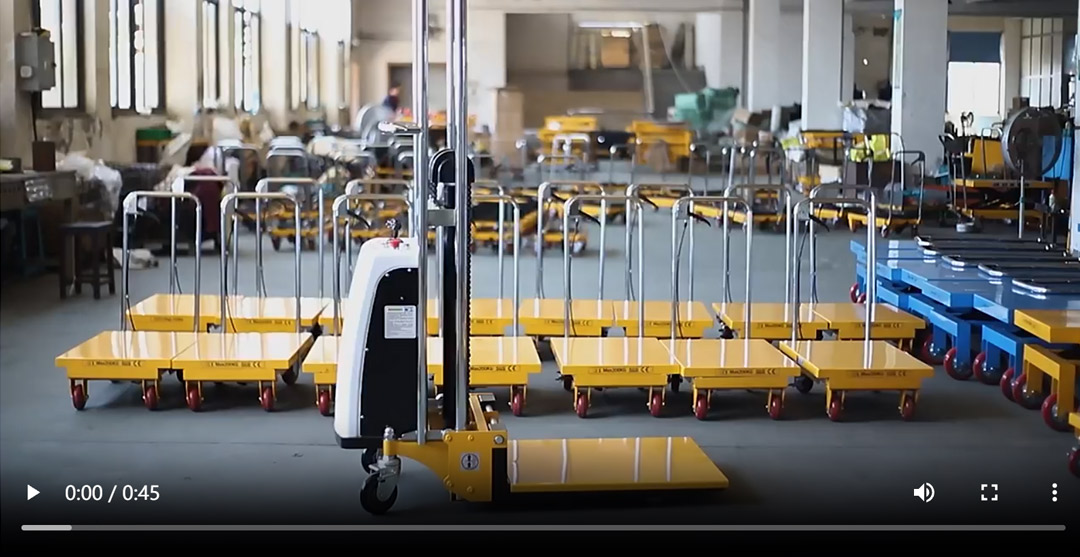
Manual platform vehicles are mainly divided into two categories: flat plate and hydraulic lifting, and their core characteristics have certain adaptability to the handling requirements of precision instruments:
- Flexibility: With a compact size and small turning radius, it is suitable for operating in narrow spaces such as laboratories and workshops, and can accurately connect to the storage location of instruments;
- Controllability: Manual operation can accurately control the movement speed and lifting height, avoiding possible sudden power fluctuations of electric equipment and reducing the risk of instrument impact;
- Cost effectiveness: No need for power supply, simple maintenance, suitable for frequent but low load short distance transportation scenarios;
- Customized adaptation: Some manual platform vehicles are equipped with shock-absorbing universal wheels, anti-skid platforms, level gauges, and other functions, which can meet the core requirements of precision instruments for “stability” and “accuracy” – for example, the smooth lifting of hydraulic lifting platform vehicles can reduce the impact during loading and unloading, and the shock-absorbing wheels can absorb small ground bumps.
The transportation requirements for precision instruments are focused on “stability (avoiding vibration and tilting), accuracy (precise positioning and docking), and lightness (moderate operating force)”. If the manual platform vehicle is selected properly, it can basically cover these requirements.
2、 Key risks and avoidance measures for transporting precision instruments
Although manual platform vehicles have adaptability, there are still risks associated with transporting precision instruments that need to be avoided in a targeted manner
- Vibration damage: Sensitive components such as optical lenses and sensors inside the instrument are extremely sensitive to vibration. Avoidance method: select the model with rubber shock absorption wheel, lay cushion materials such as pearl cotton and shockproof foam on the platform, move at a constant speed during operation, and avoid sudden stop and sudden turn;
- Excessive tilt: Some instruments (such as laser interferometers) require a tilt angle of no more than 3 °, otherwise it will affect internal calibration. Avoidance method: use a platform truck with a level gauge, adjust the level of the platform before transportation, and avoid concave and convex roads or steep slopes (the gradient should be ≤ 5 °) during the movement;
- Collision friction: The instrument casing or interface is prone to damage due to collision. Avoidance method: Wrap the instrument with bubble wrap, install protective barriers at the edge of the platform, and collaborate with multiple people to control the direction of movement to avoid contact with obstacles;
- Dust pollution prevention: Precision instruments are easily affected by dust inside. Avoidance method: Cover the instrument with dust-proof cloth during transportation, choose a clean path, and avoid passing through areas with a lot of dust.
3、 Standardize operational procedures to ensure safe handling
To safely use a manual platform truck to transport precision instruments, the following process should be followed:
- Preliminary preparation: Select a platform vehicle with a load-bearing capacity of ≥ 20% based on the weight of the instrument, and check whether the wheels and hydraulic system are normal; Package and protect the instrument (bubble film+foam fixation), and place it in the center of the platform to avoid the center of gravity deviation;
- Path planning: Clear obstacles in advance, choose a flat route, and if you need to go uphill or downhill, have a dedicated person assist in stabilizing at the bottom/top of the slope;
- Operation process: Hold the handle with both hands and move forward at a constant speed. When turning, slow down and increase the turning radius; Slowly operate the hydraulic pump when lifting the platform to avoid instrument shaking caused by rapid lifting;
- Unloading process: Align the platform car with the target position, adjust the height to be level with the workbench, and slowly push the instrument (avoid dragging) to the target position.
4、 Practical application scenario verification
In practical scenarios, manual platform vehicles have been successfully used for the transportation of various precision instruments:
-Laboratory scene: scientific researchers use hydraulic manual platform trucks to transport small gas chromatographs, and ensure that the accuracy of the instrument is not affected by laying shockproof foam and controlling the moving speed;
-Electronic manufacturing scenario: Workers use platform vehicles with shock-absorbing wheels to transport precision PCB inspection equipment, achieving smooth transfer within a short distance;
-Medical scenario: A manual platform vehicle with a dust cover is used to transport small ultrasound diagnostic instruments, meeting the transportation needs in a sterile environment.
These cases demonstrate that as long as appropriate equipment is selected and operating procedures are strictly followed, manual platform trucks can safely transport precision instruments.
Conclusion
A manual platform vehicle is a feasible tool for transporting precision instruments, but it is necessary to select an appropriate vehicle model based on the characteristics of the instrument (such as a hydraulic lifting type with shock-absorbing wheels and a level), and take effective protective measures and standardized operation. It is particularly suitable for small and medium-sized, short distance transportation scenarios, which can reduce transportation costs while ensuring safety. But for ultra large and high-precision instruments (such as large lithography machines), professional precision handling equipment is required, and manual platform vehicles may not be able to meet the needs.
In short, the applicability of manual platform vehicles depends on the type of instrument, handling distance, and operating standards – reasonable use can become an efficient auxiliary tool for precision instrument handling.